George Stepaniants
Assistant Professor, Department of Applied Mathematics and Theoretical Physics, University of Cambridge
Visiting Faculty, Courant Institute, New York University
About Me
I am an Assistant Professor in Mathematics of Information in the Department of Applied Mathematics and Theoretical Physics (DAMTP) at the University of Cambridge. I am also visiting faculty at New York University's Courant Institute for the 2026-2027 academic year.
In 2026-2027, I serve as Part III Subject Advisor for the ACDA subgroup within DAMTP and organize the DAMTP ACDA Colloquium.
Previously, I was an NSF MSPRF postdoctoral fellow at the California Institute of Technology in the Department of Computing and Mathematical Sciences working with Prof. Andrew Stuart. I received my PhD from the Massachusetts Institute of Technology (MIT) in 2024 in the Department of Mathematics co-advised by Prof. Philippe Rigollet and Prof. Jörn Dunkel funded by the NSF GRFP and MIT Presidential Fellowship. At MIT, I was also part of the Interdisciplinary Doctoral Program in Statistics (IDPS) through the Institute for Data, Systems, and Society (IDSS).
Prior to MIT, I graduated in 2019 from the University of Washington with a Bachelor of Science in Mathematics and Computer Science, where I performed research in the Department of Applied Mathematics with Prof. Nathan Kutz.
I have broad interests in scientific machine learning, computer-assisted mathematics, dynamical systems, and optimal transport. My research develops methods for efficient and accurate model inference and prediction in complex physical systems, backed by rigorous analysis, approximation bounds, and statistical guarantees.
Research Mission
How do we develop physically faithful models and solve inverse problems when data are collected from disparate sources, sample-limited and noisy, or only available as partial observations of a larger system?
-
(I)Advancement of statistical and machine learning methods to learn governing physical laws from data in noisy and data-sparse regimes, with analytical, approximation theoretic, and statistical guarantees
-
(II)Development of optimal transport techniques for alignment and pooling of scientific data from disparate sources, with rigorous finite-sample guarantees
-
(III)Advancing mathematical theory and numerical algorithms for inverse problems with applications to spatial and temporal deconvolution and to systems with nonlocal and long-range interactions
The methodological and theoretical developments in these three thrusts are guided by my work in specific application domains including biochemistry, materials science, and fluid mechanics.
Education

University of Washington
BSc (2015-2019)
Math and Computer Science Double Major
Massachusetts Institute of Technology
PhD (2019-2024)
NSF GRFP Graduate Student in Mathematics and Statistics
California Institute of Technology
Postdoc (2024-2026)
NSF MSPRF Postdoctoral Researcher
News Highlights
-
Oct 2026
Joined Cambridge as Assistant Professor; visiting NYU Courant in 2026-2027
-
Aug 2026
Isaac Newton Institute 2026 Simons Fellow
-
Apr 2026
ILAS 2026 Early Career NSF Conference Grant Award Recipient
-
Jun 2025
Invited Speaker at Banff BIRS Workshop (Efficient and Reliable Deep Learning)
-
Sep 2024
NSF Mathematical Sciences Postdoctoral Research Fellow (MSPRF)
-
Sep 2024
IMS Lawrence D. Brown Ph.D. Student Award Recipient (3 recipients nationwide)
-
Jul 2024
Invited Speaker at Fields Institute Symposium (Machine Learning and Dynamical Systems)
-
Jun 2023
Presented at Armenian Statistics Summer School under Calouste Gulbenkian Travel Grant
-
Dec 2021
Invited Speaker at CIRM (Meeting on Mathematical Statistics)
-
Sep 2019
NSF Graduate Research Fellow (GRFP)
-
Sep 2019
MIT Presidential Fellow
-
Jun 2019
Elected to Phi Beta Kappa Honors Society
Research
A Complete Resolution of Forsythe's Conjecture for Restarted Conjugate Gradients
Matthew J. Colbrook, George Stepaniants, and Alex Townsend
arXiv preprint, 2026A computer-assisted counterexample to the planar Berenstein conjecture
Matthew J. Colbrook, Siavash Sadeghi, and George Stepaniants
arXiv preprint, 2026A Proof of the Forsythe Conjecture for the Two-Step Restarted Conjugate Gradient Method
Matthew J. Colbrook, George Stepaniants, and Alex Townsend
arXiv preprint, 2026A computer-assisted counterexample to the planar Pompeiu and Schiffer conjectures
Matthew J. Colbrook and George Stepaniants
arXiv preprint, 2026Learning Memory and Material Dependent Constitutive Laws
Kaushik Bhattacharya, Lianghao Cao, George Stepaniants, Andrew M. Stuart, and Margaret Trautner
SMAI Journal of Computational Mathematics, 2026A Spectral Theory of Scalar Volterra Equations
David Darrow and George Stepaniants
Communications of the AMS, 2026Covariance alignment: from maximum likelihood estimation to Gromov-Wasserstein
Yanjun Han, Philippe Rigollet, and George Stepaniants
SIMODS, 2025Discovering dynamics and parameters of nonlinear oscillatory and chaotic systems from partial observations
George Stepaniants, Alasdair D. Hastewell, Dominic J. Skinner, Jan F. Totz, and Jörn Dunkel
PRR, 2024Optimal transport for automatic alignment of untargeted metabolomic data
Marie Breeur, George Stepaniants, Pekka Keski-Rahkonen, Philippe Rigollet, and Vivian Viallon
eLife, 2024Learning partial differential equations in reproducing kernel Hilbert spaces
George Stepaniants
JMLR, 2023GULP: a prediction-based metric between representations
Enric Boix-Adserà, Hannah Lawrence, George Stepaniants, and Philippe Rigollet
NeurIPS, 2022Fast and smooth interpolation on Wasserstein space
Sinho Chewi, Julien Clancy, Thibaut Le Gouic, Philippe Rigollet, George Stepaniants, and Austin Stromme
AISTATS, 2021Inferring causal networks of dynamical systems through transient dynamics and perturbation
George Stepaniants, Bingni W. Brunton, and J. Nathan Kutz
Physical Review E, 2020The Lebesgue Integral, Chebyshev's Inequality, and the Weierstrass Approximation Theorem
George Stepaniants
Undergraduate Academic Report, 2017A Complete Resolution of Forsythe's Conjecture for Restarted Conjugate Gradients
Matthew J. Colbrook, George Stepaniants, and Alex Townsend
https://arxiv.org/abs/2609.04659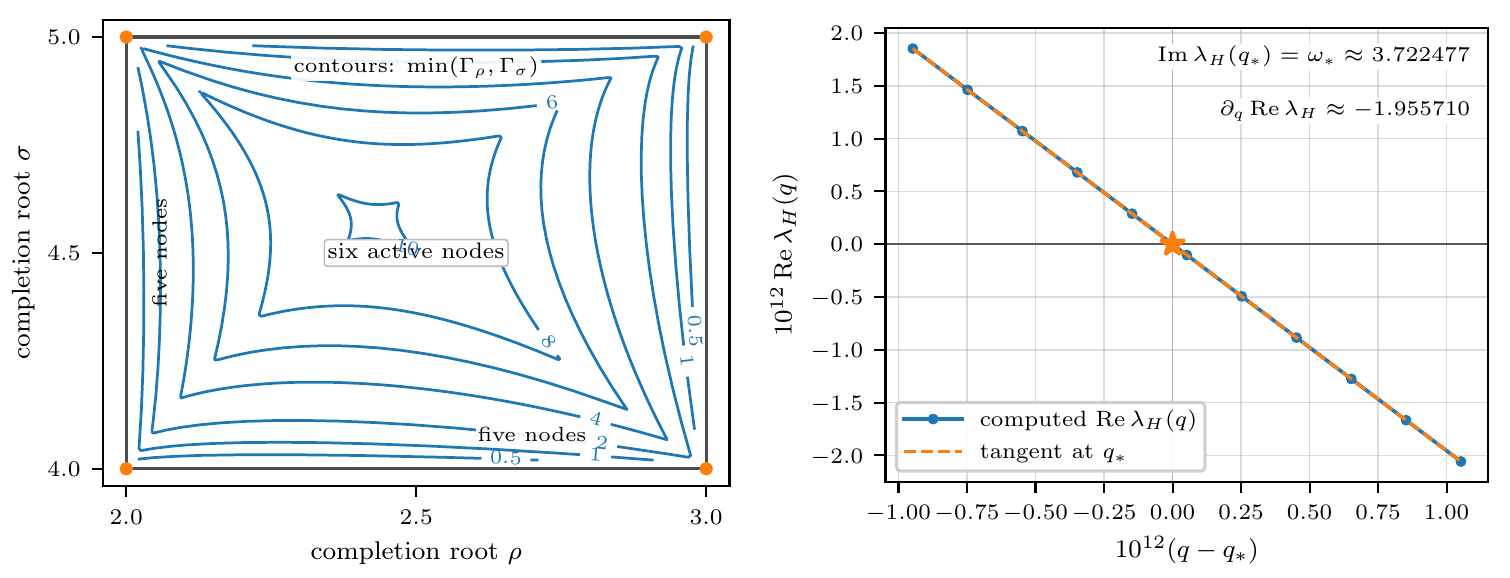
Figure 1. The threshold mechanism: the parameter rectangle of limiting two-cycles for restart length three (left), and a numerical reconstruction of the certified transverse Hopf crossing for restart length four (right).
View full figure from the research card- Venue: arXiv preprint arXiv:2609.04659
- Date: September 4, 2026
- Keywords: conjugate gradient method, restarted Krylov method, Forsythe conjecture, orthogonal polynomials, Hopf bifurcation, computer-assisted proof
Summary
We give a complete classification of Forsythe's conjecture by restart length for exact-arithmetic restarted conjugate gradients on finite-dimensional symmetric positive definite problems. For restart lengths two and three, every iteration either terminates or has even and odd normalized residual directions that converge separately. Combined with the classical result for restart length one, this establishes the conjecture precisely for restart lengths one, two, and three. For every restart length s of four or more, we construct a diagonal positive definite counterexample of dimension s + 4 whose even residual directions do not converge. The proof combines a double-orthogonality identity and low-degree fixed-set analysis with a computer-certified Hopf bifurcation, analytic periodic-orbit and shadowing arguments, and degree elevation. A Lean formalization also verifies the classification for all restart lengths of two or more.
A computer-assisted counterexample to the planar Berenstein conjecture
Matthew J. Colbrook, Siavash Sadeghi, and George Stepaniants
https://arxiv.org/abs/2608.08953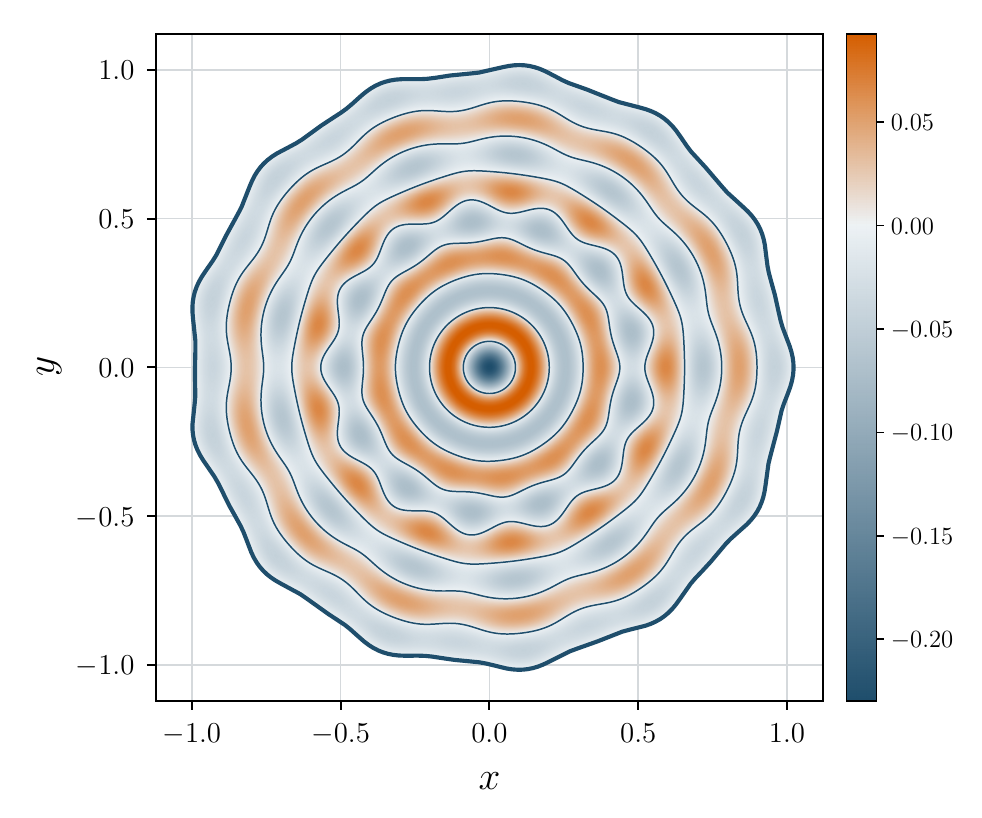
Figure 1. Numerical approximation to the sign-changing eigenfunction on the Berenstein counterexample domain.
View full figure from the research card- Venue: arXiv preprint arXiv:2608.08953
- Date: August 9, 2026
- Keywords: Berenstein conjecture, overdetermined eigenvalue problems, spectral geometry, computer-assisted proof, interval arithmetic
Summary
We construct a noncircular, simply connected planar domain with an analytic boundary that supports a sign-changing Helmholtz eigenfunction with zero boundary values and a constant nonzero normal derivative. This gives a counterexample to the unrestricted planar Berenstein conjecture. The domain has thirteen-fold rotational symmetry and is not centrally symmetric. Building on the conformal and disk-polynomial framework developed for the Pompeiu and Schiffer problems, we formulate a coupled interior-boundary system on the unit disc. Bounds on the infinite-dimensional tail and an interval-arithmetic verification of a Newton-Kantorovich argument establish the existence of an exact solution near the computed approximation.
A Proof of the Forsythe Conjecture for the Two-Step Restarted Conjugate Gradient Method
Matthew J. Colbrook, George Stepaniants, and Alex Townsend
https://arxiv.org/abs/2608.02852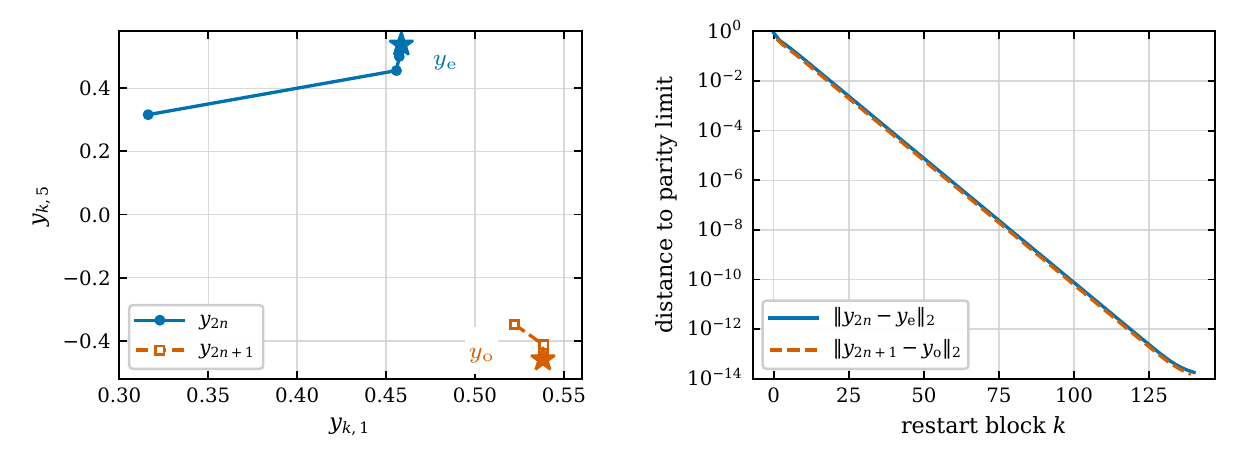
Figure 1. Two-step restarted conjugate gradients: residual trajectories and convergence to the even and odd limiting states.
View full figure from the research card- Venue: arXiv preprint arXiv:2608.02852
- Date: August 3, 2026
- Keywords: conjugate gradient method, restarted Krylov method, Forsythe conjecture, orthogonal polynomials, asymptotic residual directions
Summary
We resolve the two-step case of Forsythe's 1968 conjecture on the asymptotic behavior of restarted conjugate gradients. For a symmetric positive definite system, restarting after every two iterations produces normalized residuals whose even and odd subsequences each approach a limit, provided the iteration does not terminate. Thus the residual directions asymptotically settle into a two-cycle.
A computer-assisted counterexample to the planar Pompeiu and Schiffer conjectures
Matthew J. Colbrook and George Stepaniants
https://arxiv.org/abs/2608.01579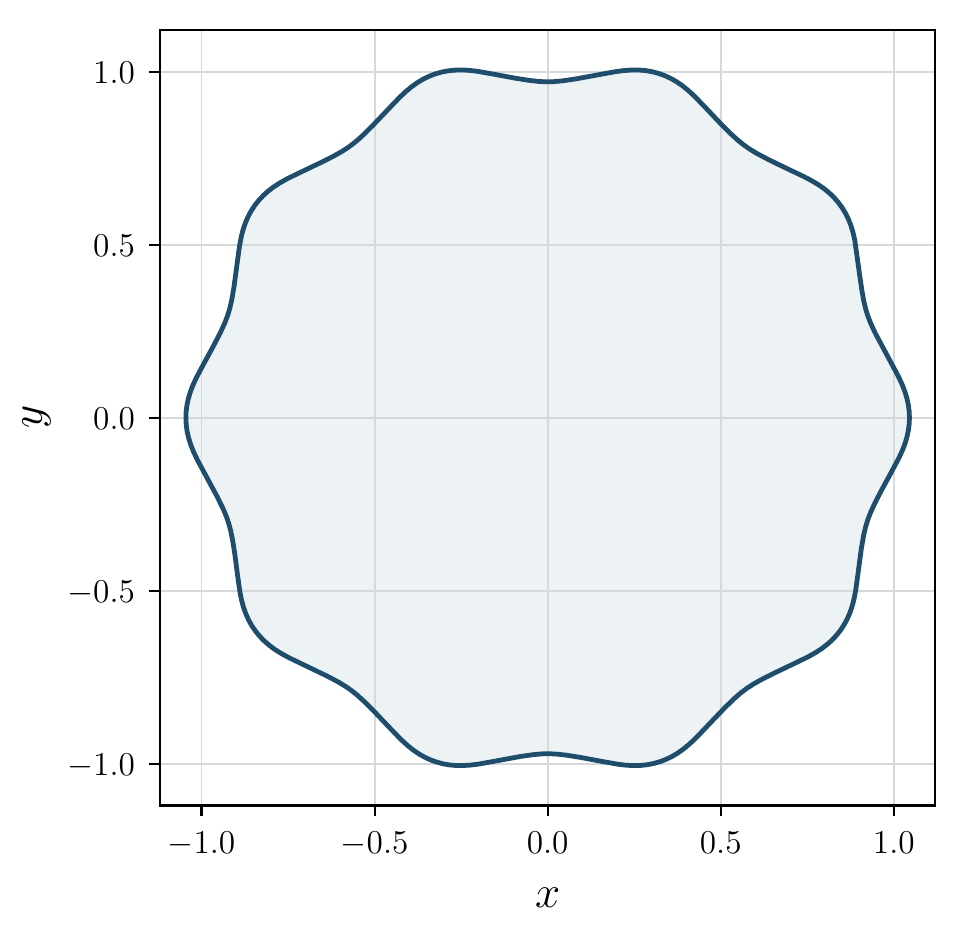
Figure 1. Boundary of the finite conformal approximation to the ten-lobed counterexample domain.
View full figure from the research card- Venue: arXiv preprint arXiv:2608.01579
- Date: August 3, 2026
- Keywords: Pompeiu problem, Schiffer conjecture, spectral geometry, conformal mapping, computer-assisted proof
Summary
We give a computer-assisted construction of a noncircular, simply connected planar domain with an analytic boundary and a nonconstant Neumann eigenfunction that is constant on the boundary. The domain disproves the planar Schiffer conjecture and, through Green's identity, also the corresponding Pompeiu conjecture. Its boundary has ten-fold rotational symmetry and closely follows an explicitly specified polynomial conformal map. Transferring the problem to the unit disc yields an operator equation in a disk-polynomial basis. Rigorous coefficient estimates and control of the infinite-dimensional tails establish an exact solution near the numerical approximation.
Learning Memory and Material Dependent Constitutive Laws
Kaushik Bhattacharya, Lianghao Cao, George Stepaniants, Andrew M. Stuart, and Margaret Trautner
https://smai-jcm.centre-mersenne.org/articles/10.5802/smai-jcm.148/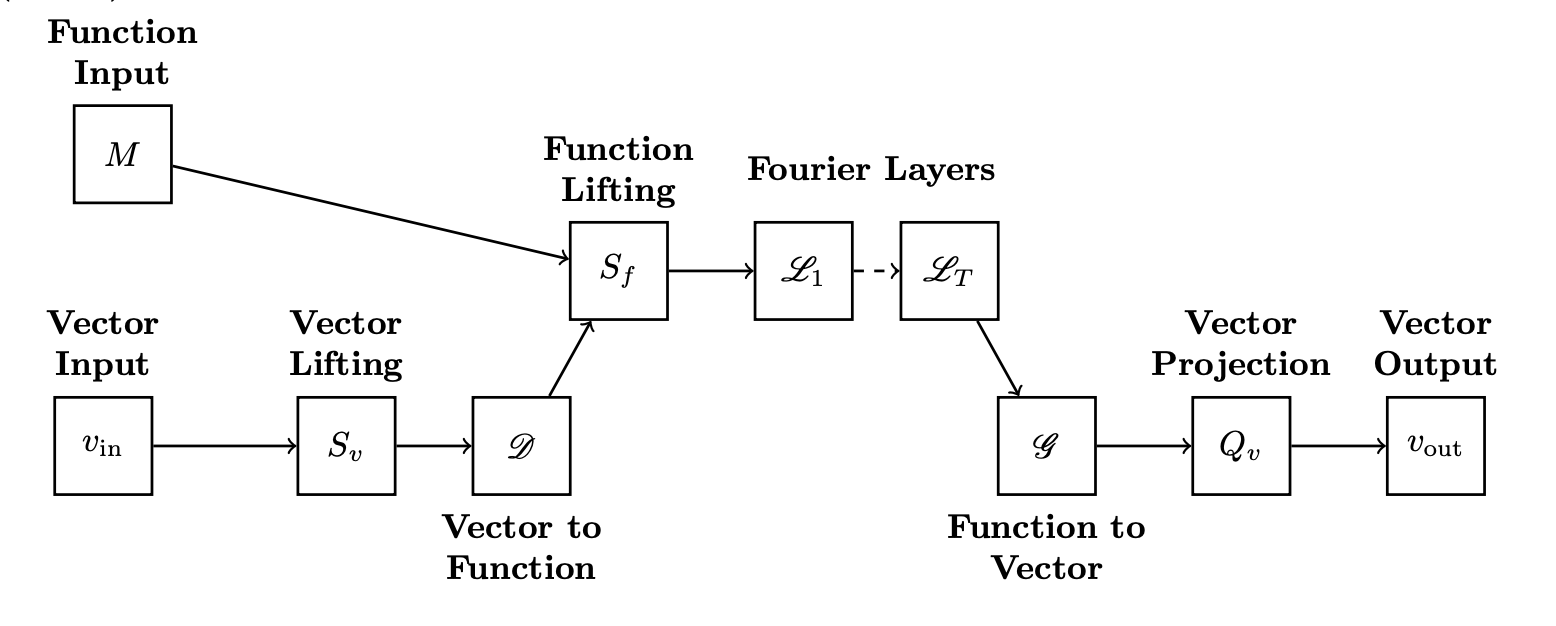 View full figure from the research card
- Venue: The SMAI Journal of Computational Mathematics
- Date: June 12, 2026
- Keywords: constitutive modeling, homogenization, memory, microstructure, Kelvin-Voigt, viscoelasticity, elasto-viscoplasticity, neural operator
Abstract
We propose and study a neural operator framework for learning memory- and material microstructure-dependent constitutive laws for heterogeneous materials. We work in the two-scale setting where homogenization theory provides a systematic approach to deriving macroscale constitutive laws, obviating the need to resolve complex microstructure repeatedly. However, the unit cell problems defining these constitutive models are typically not amenable to explicit evaluation. It is therefore of interest to learn constitutive models from data generated by the unit cell problem. Our proposed framework models homogenized constitutive laws with both memory- and microstructure-dependence through the use of Markovian recurrent and Fourier neural operators. The homogenization problem for Kelvin-Voigt viscoelastic materials is studied to provide firm theoretical foundations for our model. The theoretical properties of the cell problem in this Kelvin-Voigt setting motivate the proposed learning framework; and are also used to prove a universal approximation theorem for the learned macroscale constitutive model. Numerical experiments show that the proposed learning framework accurately learns memory- and microstructure-dependent viscoelastic and elasto-viscoplastic constitutive models, beyond the setting of the theory. Furthermore, we show that the learned constitutive models can be successfully deployed in macroscale simulation of material deformation for different microstructures without retraining.
A Spectral Theory of Scalar Volterra Equations
David Darrow and George Stepaniants
https://doi.org/10.1090/cams/64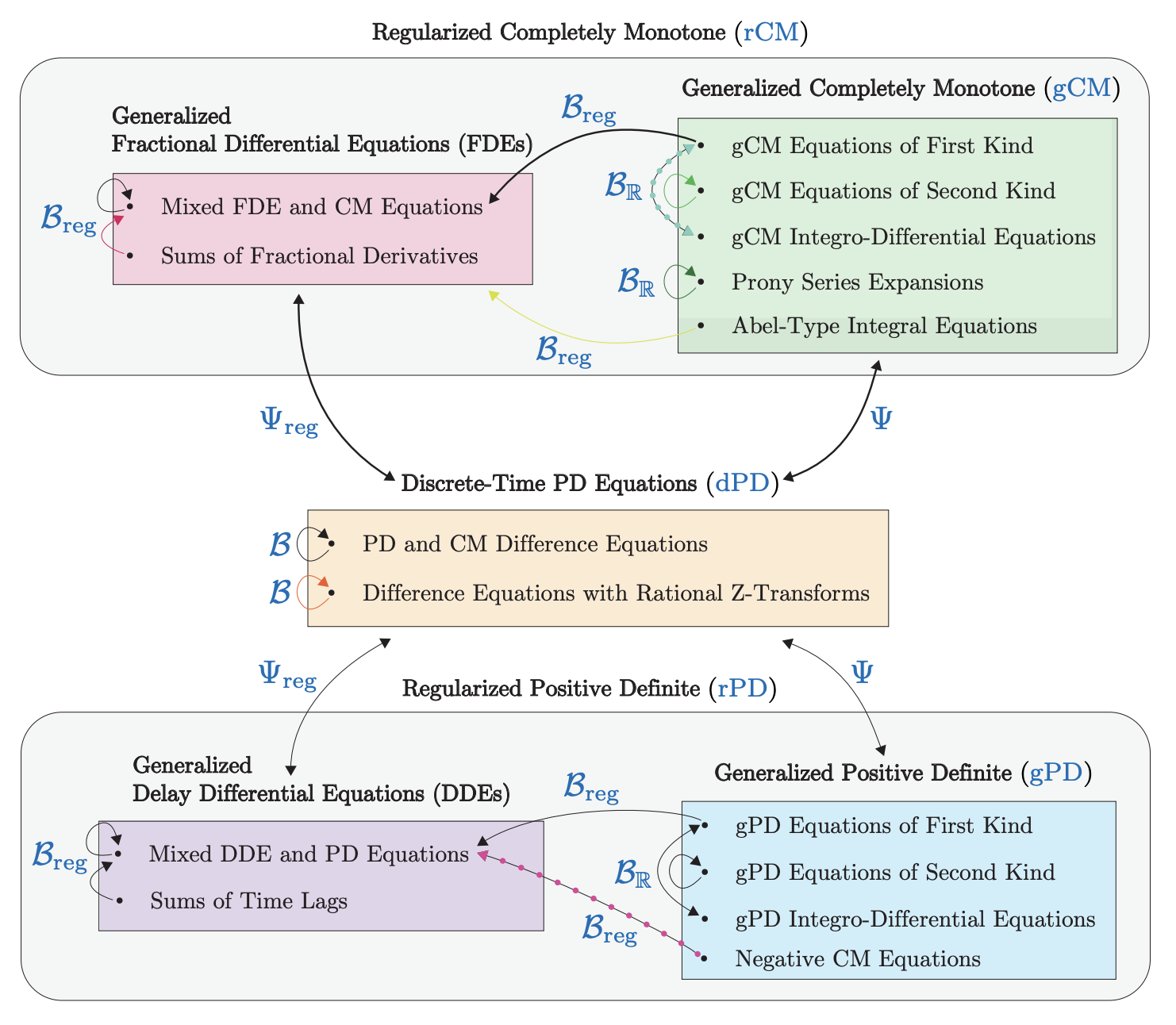 View full figure from the research card
- Venue: Communications of the American Mathematical Society
- Date: May 20, 2026
- Keywords: Volterra integral equations, constitutive modeling, fractional derivatives, delay differential equations
Abstract
This work aims to bridge the gap between pure and applied research on scalar, linear Volterra equations by examining five major classes: integral and integro-differential equations with completely monotone kernels (viscoelastic models); equations with positive definite kernels (partially observed quantum systems); difference equations with discrete, positive definite kernels; a generalized class of delay differential equations; and a generalized class of fractional differential equations. We develop a general, spectral theory that provides a system of correspondences between these disparate domains. As a result, we see how 'interconversion' (operator inversion) arises as a natural, continuous involution within each class, yielding a plethora of novel formulas for analytical solutions of such equations. This spectral theory unifies and extends existing results in viscoelasticity, signal processing, and analysis. It also introduces a geometric construction of the regularized Hilbert transform, revealing a fundamental connection to fractional and delay differential equations. Finally, it offers a practical toolbox for Volterra equations of all classes, reducing many to pen-and-paper calculations and introducing a powerful spectral approach for general Volterra equations based on rational approximation.
Covariance alignment: from maximum likelihood estimation to Gromov-Wasserstein
Yanjun Han, Philippe Rigollet, and George Stepaniants
https://epubs.siam.org/doi/full/10.1137/24M1682841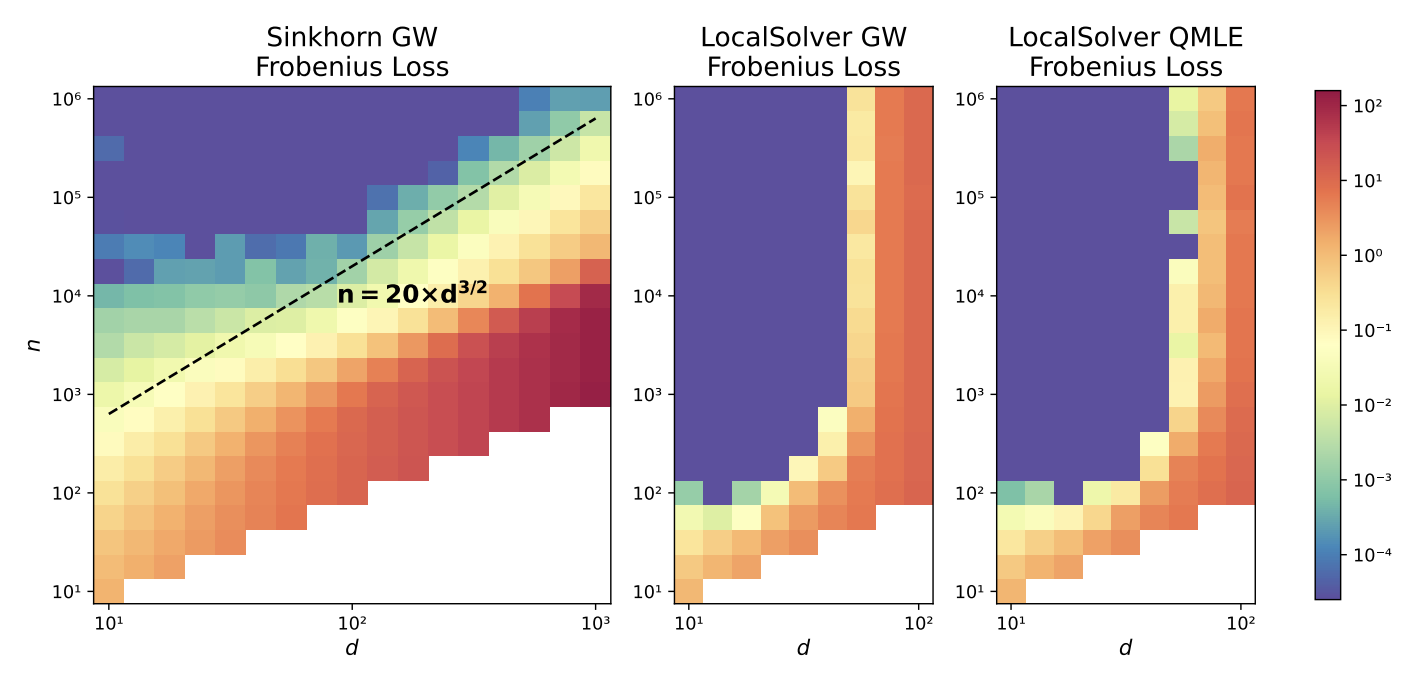 View full figure from the research card
- Venue: SIAM Journal on Mathematics of Data Science
- Date: September 17, 2025
- Keywords: Feature alignment, graph matching, optimal transport, Gromov-Wasserstein
Abstract
Feature alignment methods are used in many scientific disciplines for data pooling, annotation, and comparison. As an instance of a permutation learning problem, feature alignment presents significant statistical and computational challenges. In this work, we propose the covariance alignment model to study and compare various alignment methods and establish a minimax lower bound for covariance alignment that has a non-standard dimension scaling because of the presence of a nuisance parameter. This lower bound is in fact minimax optimal and is achieved by a natural quasi MLE. However, this estimator involves a search over all permutations which is computationally infeasible even when the problem has moderate size. To overcome this limitation, we show that the celebrated Gromov-Wasserstein algorithm from optimal transport which is more amenable to fast implementation even on large-scale problems is also minimax optimal. These results give the first statistical justification for the deployment of the Gromov-Wasserstein algorithm in practice.
Discovering dynamics and parameters of nonlinear oscillatory and chaotic systems from partial observations
George Stepaniants, Alasdair D. Hastewell, Dominic J. Skinner, Jan F. Totz, and Jörn Dunkel
https://journals.aps.org/prresearch/abstract/10.1103/PhysRevResearch.6.043062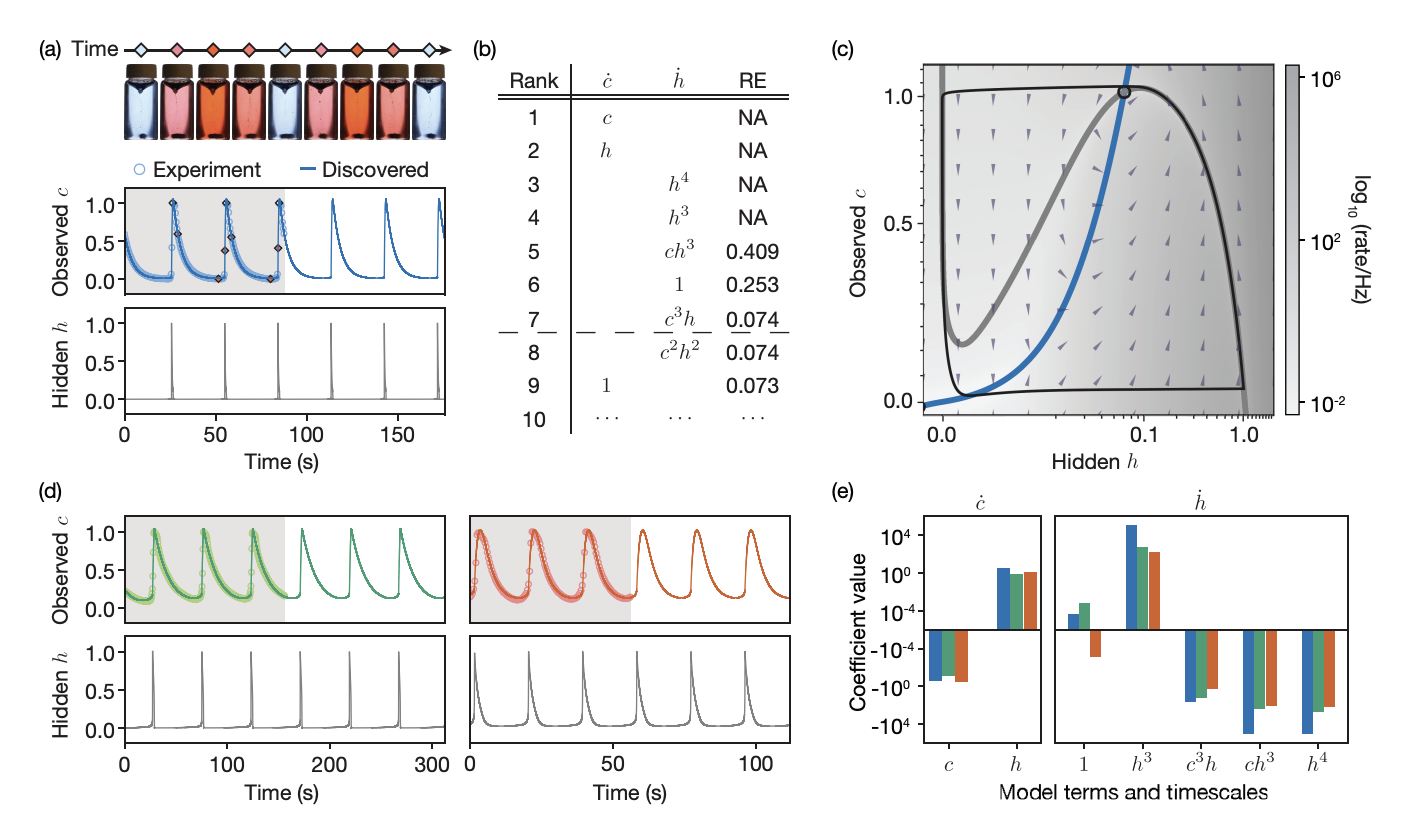 View full figure from the research card
- Venue: Physical Review Research
- Date: October 23, 2024
- Keywords: Dynamical systems, hidden variables, sensitivity methods, nonlinear oscillations, chaotic dynamics
Abstract
Despite rapid progress in data acquisition techniques, many complex physical, chemical, and biological systems remain only partially observable, thus posing the challenge to identify valid theoretical models and estimate their parameters from an incomplete set of experimentally accessible time series. Here, we combine sensitivity methods and ranked-choice model selection to construct an automated hidden dynamics inference framework that can discover predictive nonlinear dynamical models for both observable and latent variables from noise-corrupted incomplete data in oscillatory and chaotic systems. After validating the framework for prototypical FitzHugh-Nagumo oscillations, we demonstrate its applicability to experimental data from squid neuron activity measurements and Belousov-Zhabotinsky reactions, as well as to the Lorenz system in the chaotic regime.
Optimal transport for automatic alignment of untargeted metabolomic data
Marie Breeur, George Stepaniants, Pekka Keski-Rahkonen, Philippe Rigollet, and Vivian Viallon
https://elifesciences.org/articles/91597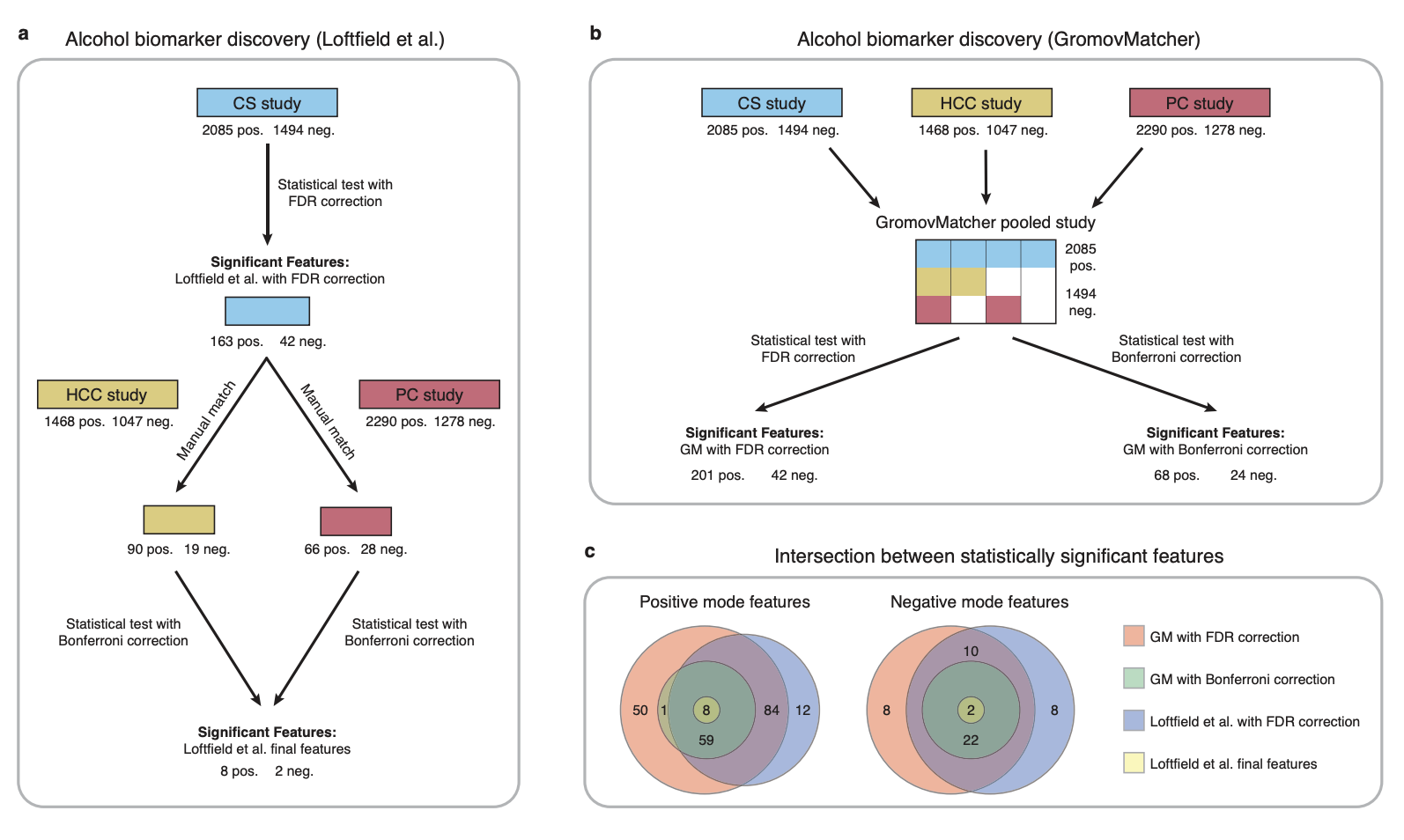 View full figure from the research card
- Venue: eLife
- Date: June 18, 2024
- Keywords: Gromov-Wasserstein, optimal transport, metabolomics, data integration
Abstract
Untargeted metabolomic profiling through liquid chromatography-mass spectrometry (LC-MS) measures a vast array of metabolites within biospecimens, advancing drug development, disease diagnosis, and risk prediction. However, the low throughput of LC-MS poses a major challenge for biomarker discovery, annotation, and experimental comparison, necessitating the merging of multiple datasets. Current data pooling methods encounter practical limitations due to their vulnerability to data variations and hyperparameter dependence. Here, we introduce GromovMatcher, a flexible and user-friendly algorithm that automatically combines LC-MS datasets using optimal transport. By capitalizing on feature intensity correlation structures, GromovMatcher delivers superior alignment accuracy and robustness compared to existing approaches. This algorithm scales to thousands of features requiring minimal hyperparameter tuning. Manually curated datasets for validating alignment algorithms are limited in the field of untargeted metabolomics, and hence we develop a dataset split procedure to generate pairs of validation datasets to test the alignments produced by GromovMatcher and other methods. Applying our method to experimental patient studies of liver and pancreatic cancer, we discover shared metabolic features related to patient alcohol intake, demonstrating how GromovMatcher facilitates the search for biomarkers associated with lifestyle risk factors linked to several cancer types.
Learning partial differential equations in reproducing kernel Hilbert spaces
George Stepaniants
https://jmlr.org/papers/v24/21-1363.html View full figure from the research card
- Venue: Journal of Machine Learning Research
- Date: January 25, 2023
- Keywords: Green's functions, partial differential equations, reproducing kernel Hilbert spaces, functional linear regression, simultaneous diagonalization
Abstract
We propose a new data-driven approach for learning the fundamental solutions (Green's functions) of various linear partial differential equations (PDEs) given sample pairs of input-output functions. Building off the theory of functional linear regression (FLR), we estimate the best-fit Green's function and bias term of the fundamental solution in a reproducing kernel Hilbert space (RKHS) which allows us to regularize their smoothness and impose various structural constraints. We derive a general representer theorem for operator RKHSs to approximate the original infinite-dimensional regression problem by a finite-dimensional one, reducing the search space to a parametric class of Green's functions. In order to study the prediction error of our Green's function estimator, we extend prior results on FLR with scalar outputs to the case with functional outputs. Finally, we demonstrate our method on several linear PDEs including the Poisson, Helmholtz, Schrödinger, Fokker-Planck, and heat equation. We highlight its robustness to noise as well as its ability to generalize to new data with varying degrees of smoothness and mesh discretization without any additional training.
GULP: a prediction-based metric between representations
Enric Boix-Adserà, Hannah Lawrence, George Stepaniants, and Philippe Rigollet
https://arxiv.org/abs/2210.06545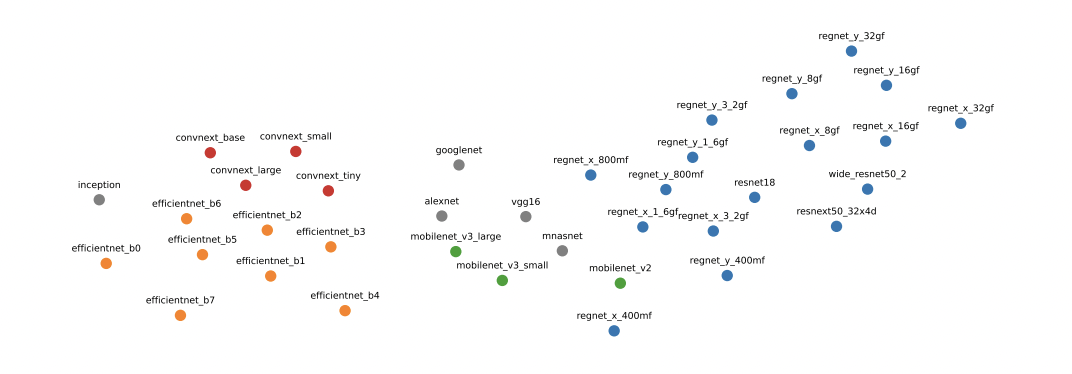 View full figure from the research card
- Venue: Advances in Neural Information Processing Systems
- Date: October 12, 2022
- Keywords: representations, CCA, CKA, transfer learning, neural networks
Abstract
Comparing the representations learned by different neural networks has recently emerged as a key tool to understand various architectures and ultimately optimize them. In this work, we introduce GULP, a family of distance measures between representations that is explicitly motivated by downstream predictive tasks. By construction, GULP provides uniform control over the difference in prediction performance between two representations, with respect to regularized linear prediction tasks. Moreover, it satisfies several desirable structural properties, such as the triangle inequality and invariance under orthogonal transformations, and thus lends itself to data embedding and visualization. We extensively evaluate GULP relative to other methods, and demonstrate that it correctly differentiates between architecture families, converges over the course of training, and captures generalization performance on downstream linear tasks.
Fast and smooth interpolation on Wasserstein space
Sinho Chewi, Julien Clancy, Thibaut Le Gouic, Philippe Rigollet, George Stepaniants, and Austin Stromme
https://proceedings.mlr.press/v130/chewi21a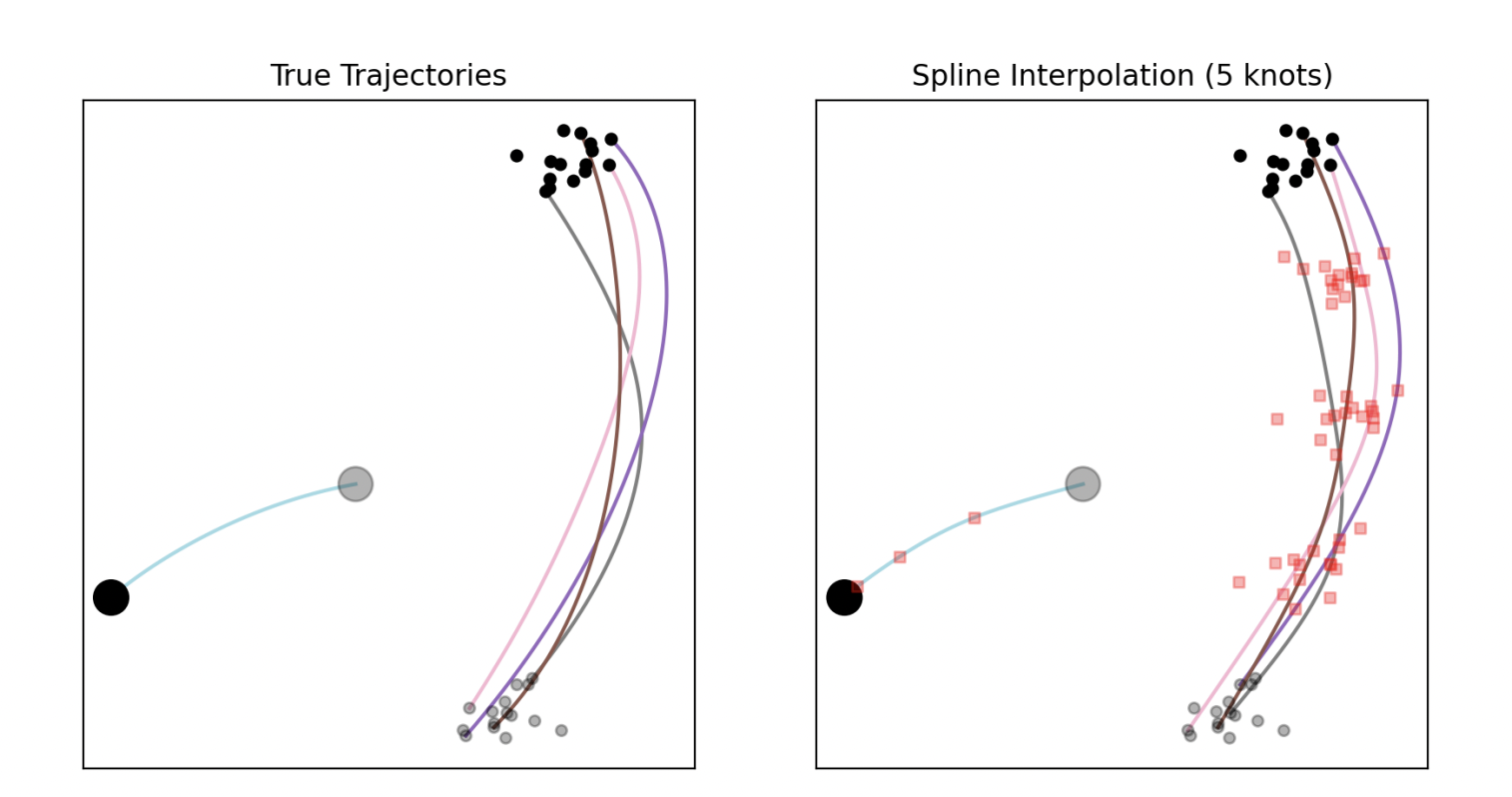 View full figure from the research card
- Venue: International Conference on Artificial Intelligence and Statistics
- Date: March 18, 2021
- Keywords: optimal transport, spline interpolation, thin-plate splines
Abstract
We propose a new method for smoothly interpolating probability measures using the geometry of optimal transport. To that end, we reduce this problem to the classical Euclidean setting, allowing us to directly leverage the extensive toolbox of spline interpolation. Unlike previous approaches to measure-valued splines, our interpolated curves (i) have a clear interpretation as governing particle flows, which is natural for applications, and (ii) come with the first approximation guarantees on Wasserstein space. Finally, we demonstrate the broad applicability of our interpolation methodology by fitting surfaces of measures using thin-plate splines.
Inferring causal networks of dynamical systems through transient dynamics and perturbation
George Stepaniants, Bingni W. Brunton, and J. Nathan Kutz
https://journals.aps.org/pre/abstract/10.1103/PhysRevE.102.042309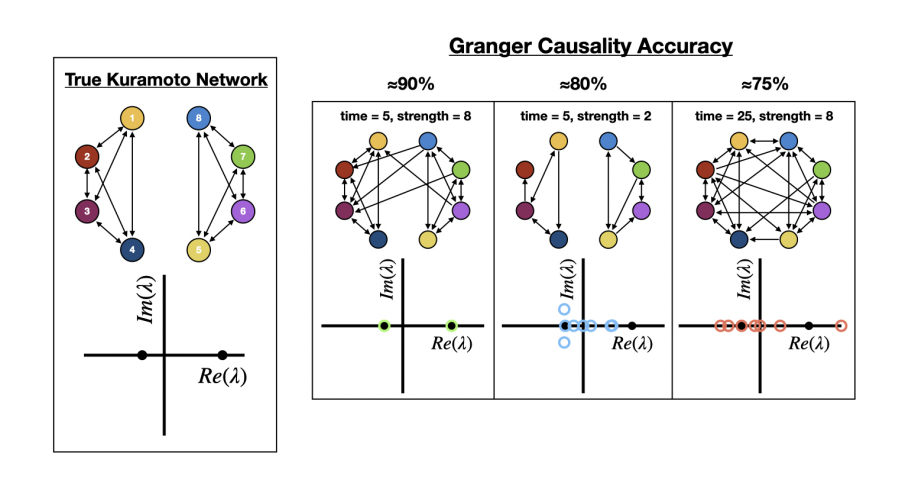 View full figure from the research card
- Venue: Physical Review E
- Date: October 26, 2020
- Keywords: network inference, coupled oscillators, Granger causality, CCA
Abstract
Inferring causal relations from time series measurements is an ill-posed mathematical problem, where typically an infinite number of potential solutions can reproduce the given data. We explore in depth a strategy to disambiguate between possible underlying causal networks by perturbing the network, where the forcings are either targeted or applied at random. The resulting transient dynamics provide the critical information necessary to infer causality. Two methods are shown to provide accurate causal reconstructions: Granger causality (GC) with perturbations, and our proposed perturbation cascade inference (PCI). Perturbed GC is capable of inferring smaller networks under low coupling strength regimes. Our proposed PCI method demonstrated consistently strong performance in inferring causal relations for small (2-5 node) and large (10-20 node) networks, with both linear and nonlinear dynamics. Thus, the ability to apply a large and diverse set of perturbations to the network is critical for successfully and accurately determining causal relations and disambiguating between various viable networks.
The Lebesgue Integral, Chebyshev's Inequality, and the Weierstrass Approximation Theorem
George Stepaniants
https://sites.math.washington.edu/~morrow/336_17/papers17/george.pdf View full figure from the research card
- Venue: Undergraduate Academic Report (Math 33X, University of Washington)
- Date: June 6, 2017
- Keywords: Lebesgue integral, Chebyshev's inequality, Weierstrass approximation theorem
Abstract
This paper presents Bernstein's probabilistic proof of the Weierstrass Approximation Theorem. It develops the required foundations in measure theory, Lebesgue integration, probability distributions, and Chebyshev's inequality before applying them to polynomial approximation.
Teaching Philosophy
My goal as an educator is to teach students how to work on the interface of different disciplines and leverage tools from mathematical theory in physics, life sciences, probability theory, and statistics to solve their problems. My teaching philosophy is to train students to
- (1.) Identify promising ideas or undeveloped theories in domain-specific literature
- (2.) Translate these ideas into precise theoretical frameworks
- (3.) Bring these frameworks to life as numerical algorithms and reproducible code
I am dedicated to mentoring and student outreach, and am taking important steps in education, research mentorship, and outreach in academia as well as in my local communities. I continue to expand my outreach and service in communities that historically have had less access to education in mathematics and science.
Instructor of Record
ACM 270 Data-Driven Modeling of Dynamical Systems
Teaching Assistant
MIT 18.032 Differential Equations
MIT 18.600 Introduction to Probability
Mentorship and Outreach
(SURF) California Institute of Technology
Summer 2025
Undergraduate Research Mentor for Vladislav Syntko (Maastricht University, Netherlands)
A Signature-Based Approach for System Identification and Control: Applications and theory for signature transform methods in open-loop control of dynamical systems.
(WAVE) California Institute of Technology
Summer 2025
Undergraduate Research Mentor for Owen Tolbert (University of Maryland Baltimore County)
A Study of Network Inference Methods: Information-theoretic and deep learning methods for inference of networked dynamical systems.
(MCM) California Institute of Technology
Fall 2024
Trained three undergraduate Caltech teams for the Mathematical Contest in Modeling (MCM), coaching and solving practice problems over the course of several months
- (Honorable Mention) Gautham Kappaganthula, Constantin Cedillo-Vayson de Pradenne, Colin La
- (Successful Participant) Joseph Pieper, Sujay Champati, Dhruv Verma
- (Successful Participant) James Hou, Aman Burman, Abhiram Cherukupalli
(Mentor) California Institute of Technology
Fall 2024
Undergraduate Research Mentor for Zixiang Zhou (University of Southern California)
Mentored research reading and project in data-driven dynamical systems inference algorithms based on the method of characteristics.
(SPUR+) Massachusetts Institute of Technology
Summer 2023 - Fall 2023
Undergraduate Research Mentor for Elaine Liu (Massachusetts Institute of Technology)
Modeling International Trade and Tariffs: Study of large trade and tariffs dataset across 200 world countries, investigating the use of spectral and graph wavelet decompositions for analysis of temporal trade network data.
(DRP) Massachusetts Institute of Technology
Summer 2023
Directed Reading Program with Loreta Arzumanyan and Joshua Curtis Kuffour (Massachusetts Institute of Technology)
Guided reading of two undergraduate students in the graduate dynamical systems text "Stability, Instability and Chaos" by Paul Glendinning over the course of the summer. Prepared students to present their knowledge of the text in a final presentation at the end of summer.
(Mentor) Massachusetts Institute of Technology
Summer 2023
Undergraduate Research Mentor for Donald J. Liveoak and Hanna Chen (Massachusetts Institute of Technology)
Guided research readings with two MIT undergraduates on optimal transport and adjoint methods for inference of stochastic dynamical systems and networked dynamical systems.
(UROP) Massachusetts Institute of Technology
Fall 2021 - Spring 2022
Undergraduate Research Mentor for David Darrow (Massachusetts Institute of Technology)
Optimal Transport for Protein Folding: Studying how optimal transport and Gromov-Wasserstein methods can be used to predict the three-dimensional structure of proteins.
(Community Service) University of Washington
2015 - 2019
Math tutoring from K12 to college-level subjects
2015 - 2016
Teaching assistant at University of Washington Math Circle
Service and Leadership
Part III Subject Advisor for the ACDA subgroup, DAMTP, University of Cambridge
2026 - 2027
Organizer of Caltech CMS Departmental CMX Seminar
2025 - 2026
Organizer of SURF/WAVE undergraduate research across three faculty at Caltech CMS
2025
Presenter on AI literacy and societal impact in LA and NY Armenian communities
2025
Organized panel on graduate school experience and research in Redmond Armenian community
2020
Founded and led Armenian Student Association at the University of Washington (ASAUW)
2015 - 2019
Competition judge at the University of Washington Math Olympiad
2015 - 2019
Professional Membership
Institute of Mathematical Statistics (IMS)
2024 - Present
Society for Industrial and Applied Mathematics (SIAM)
2020 - Present
American Physical Society (APS)
2019 - Present
ACM 270 Data-Driven Modeling of Dynamical Systems
https://schedules.caltech.edu/syllabi/ACM270_SP2425.pdfOverview
Dynamical systems are a ubiquitous tool for modeling time-dependent processes in science and engineering. Progress in machine learning methods in the past two decades has been tremendous, giving rise to the field of scientific machine learning which combines data-driven methods with physical modeling techniques. This course covers pivotal data-driven algorithms and model architectures for more accurate model inference, forecasting, and analysis of dynamical data, with special focus on partially observed systems. Topics include system identification, Koopman theory, sparse model inference, neural ODEs, signature transforms, autoregressive models, Volterra equations, Mori-Zwanzig formalism, and higher-order models.
Responsibility
Two weekly 1.5 hour classes with 30+ students, with final presentations and projects. Designed all course content and lectures and graded final projects.
Spring 2022 | MITMIT 18.032 Differential Equations
http://student.mit.edu/catalog/search.cgi?search=18.032&style=verbatimOverview
The class 18.032 is centered around ordinary differential equations with more emphasis on theory than 18.03. Topics include first and higher-order ODEs, existence and uniqueness of solutions, Picard iterations, Euler schemes, control and comparison of solutions, maximal solutions, dependence on initial conditions, Grönwall's Lemma, multivariable ODEs, and fixed point stability.
Responsibility
Two weekly 1 hour recitations with 16 students, including grading of homeworks/finals and proctoring final exams.
Fall 2021 | MITMIT 18.600 Introduction to Probability
http://student.mit.edu/catalog/search.cgi?search=18.600&style=verbatimOverview
The class 18.600 is an introductory probability theory course. Topics include probability spaces, random variables, distribution functions, standard discrete and continuous distributions, conditional probability, Bayes theorem, joint distributions, Chebyshev inequality, the law of large numbers, and the central limit theorem.
Responsibility
Two weekly 1 hour recitations with 40 students, including grading of homeworks and finals.
Academic Employment
Oct 2026 - Present
University of Cambridge (Assistant Professor)
Assistant Professor in Mathematics of Information
Department of Applied Mathematics and Theoretical Physics (DAMTP)
Oct 2026 - Present
New York University (Visiting Faculty)
Courant Institute School of Mathematics, Computing, and Data Science
Sep 2024 - 2026
California Institute of Technology (Postdoctoral Scholar)
NSF Mathematical Sciences Postdoctoral Research Fellow (MSPRF)
Department of Computing and Mathematical Sciences (CMS)
Postdoctoral Advisor: Andrew M. Stuart
Education
Sep 2019 - Jun 2024
Massachusetts Institute of Technology (PhD)
Department of Mathematics and Institute for Data, Systems, and Society (IDSS)
GPA: 4.9/5.0
Advisors: Philippe Rigollet and Jörn Dunkel
Thesis: Inference from limited observations in statistical, dynamical, and functional problems
Sep 2015 - Jun 2019
University of Washington (BSc)
Department of Mathematics and Department of Computer Science (double major)
GPA: 3.87/4.00
Advisors: Nathan Kutz and Bing Brunton
Research Topic: Inferring causal networks of dynamical systems through transient dynamics and perturbation
Academic Awards
Isaac Newton Institute 2026 Simons Fellow
Aug 2026
ILAS 2026 Early Career NSF Conference Grant Award Recipient
Apr 2026
IMS Lawrence D. Brown Ph.D. Student Award Recipient (3 recipients nationwide)
Sep 2024
NSF Graduate Research Fellowship (GRFP)
Jun 2019 - Jun 2024
SIAM Student Travel Award
Dec 2023
Calouste Gulbenkian Foundation Short Term Conference and Travel Grant
Jun 2023
MIT Presidential Fellowship
Sep 2019 - Jun 2020
Phi Beta Kappa Honors Society Member
Jun 2019
Mary Gates Research Scholarship (merit-based)
Jun 2019
University of Washington Dean's List
Sep 2015 - Jun 2019
Early acceptance to University of Washington (UW Academy)
Sep 2015
Publications
See also my Google Scholar and ORCID.
Thesis
Preprints
Journal Articles
Conference Proceedings
In Preparation
David Darrow, George Stepaniants, and Chris Camaño. “SIEVE: Spectral integral transforms, poly-exponential approximants, and Volterra equations.”
Talks and Presentations
Organized Symposia
- “Minisymposium on Data-Driven Methods for Multiscale Modeling and Homogenization”, SIAM Conference on Computational Science and Engineering, Fort Worth, March 2025
- “Minisymposium on Data-Driven Learning of Dynamical Systems from Partial Observations”, SIAM Conference on Mathematics of Data Science, Atlanta, October 2024
Invited Talks
- “A Shortcake Counterexample to the Planar Pompeiu and Schiffer Conjectures”, Columbia Applied Mathematics Colloquium, New York, November 2026 (Upcoming) Link
- “A Shortcake Counterexample to the Planar Pompeiu and Schiffer Conjectures”, Princeton IDeAS Seminar, Princeton, September 2026 Link
- “Volterra Integral Equations and Memory Dependent Constitutive Laws”, Isaac Newton Institute, Cambridge, August 2026
- “Learning Material Constitutive Laws with Neural Operators”, ILAS, Virginia Tech, May 2026
- “Learning Dynamics with Limited Data”, UT Austin Oden Institute & Department of Statistics and Data Sciences, Online, January 2026 Link
- “Volterra Integral Equations and Memory Dependent Constitutive Laws”, UC Irvine Applied & Computational Math Seminar, Irvine, October 2025
- “Learning Memory and Material Dependent Constitutive Laws”, Surrogates and Dimension Reduction in Scientific Machine Learning, Manchester University, September 2025
- “Alignment of Untargeted Data through their Covariances: A Novel Perspective on a Classical Tool in Optimal Transport”, Joint Statistics Meeting, Nashville, August 2025 (One of 3 PhD students selected for the prestigious IMS Lawrence D. Brown PhD Student Award) Link
- “A Spectral Theory of Volterra Equations: Applications to Learning of Material Laws”, Efficient and Reliable Deep Learning Methods and their Scientific Applications, Banff BIRS Centre, June 2025
- “Learning Dynamics of Hidden Variables in Multiscale Viscoelastic Materials”, SIAM Conference on Applications of Dynamical Systems, Denver, May 2025
- “A Spectral Theory of Scalar Volterra Equations”, Dartmouth Applied & Computational Math Seminar, Dartmouth, March 2025
- “A Spectral Theory of Scalar Volterra Equations”, MIT Applied Math Physical Mathematics Seminar, Cambridge, March 2025
- “Learning Memory and Material Dependent Constitutive Laws”, Differential Equations for Data Science, Kyoto University, February 2025
- “Discovering dynamics and parameters of nonlinear oscillatory and chaotic systems from partial observations”, Fourth Symposium on Machine Learning and Dynamical Systems, Fields Institute, July 2024
- “Covariance Alignment with Optimal Transport”, Yale Applied Mathematics Seminar, New Haven, April 2024
- “Gromov-Wasserstein Theory and Application to Metabolomics”, SIAM Conference on Uncertainty Quantification, Trieste, Italy, February 2024
- “Gromov-Wasserstein Theory and Application to Metabolomics”, Statistics and Learning Theory Summer School, Tsaghkadzor, Armenia, July 2023 (One of 7 invited speakers)
- “Optimal transport for automatic alignment of untargeted metabolomic data”, Harvard Applied Math Graduate Student Seminar, Cambridge, March 2023
- “Learning PDEs in a Reproducing Kernel Hilbert Space”, SIAM Conference on Mathematics of Data Science, San Diego, September 2022
- “Learning PDEs in a Reproducing Kernel Hilbert Space”, Meeting on Mathematical Statistics, CIRM, Marseille, France, December 2021 (Only 3 graduate student speakers invited)
Contributed Talks
- “Discovering dynamics and parameters of nonlinear oscillatory and chaotic systems from partial observations”, Dynamics Days, UC Davis, January 2024
- “Learning and predicting complex systems dynamics from single-variable observations”, APS March Meeting, Chicago, March 2022
- “Learning PDEs in a Reproducing Kernel Hilbert Space”, LIDS Stats & Tea, MIT, December 2021
- “Inferring causal networks of dynamical systems through transient dynamics and perturbation”, Econometrics Lunch, MIT, December 2021
- “Fusion of Genetically Incompatible Fungal Cells”, UCLA Computational and Applied Math REU Presentation, IPAM, August 2018
- “Quantifying Rupture Risk of Brain Aneurysms”, MATDAT18: NSF Materials and Data Science Hackathon, Alexandria, June 2018 Link
- “Hyperparameter Selection”, AI2 Research Internship Final Presentation, Seattle, August 2017
- “Beaker Experimentation Platform”, AI2 Research Internship Midterm Presentation, Seattle, August 2017
- “Image Analysis in Parkinson's Research”, Pfizer Research Internship Final Presentation, Cambridge, August 2016
Poster Presentations
- “Covariance alignment: from maximum-likelihood estimation to Gromov-Wasserstein”, Cornell ORIE Young Researchers Workshop, Cornell, October 2023
- “Inferring causal networks of dynamical systems through transient dynamics and perturbation”, Undergraduate Research Symposium, UW, June 2019
Contact
Email me at gs852@cam.ac.uk or use the form below.